Insights > Opening a Path in Urban Design

Opening a Path in Urban Design

By: Bryan Bowen
My exposure to urban design began during my days as an architecture student at Carnegie Mellon University (CMU) in Pittsburgh.
I grew up in the New Mexican desert outside of sprawling Albuquerque, where urban design principles carry no sway. Our family’s passive solar home’s natural environment was fabulous, and I loved the land. Knowing I was interested in art and architecture, I enrolled in a studio at the University of New Mexico between my junior and senior year of high school and then applied to a few top architecture schools that seemed in line with those early aspirations. I’d never even been to Pennsylvania before – we couldn’t afford a school visit – so in retrospect I hardly knew what I was getting into. It turned out to be great.
In the CMU architecture studio, my peers were present and powerful influences in my education, as we toiled together through long nights collectively providing feedback and creating a sense of camaraderie. That studio culture in unforgettable. The faculty and staff were remarkable. Looking back, I was especially fortunate to work with four faculty members in particular who altered my perspective on architecture and urbanism: Stefani Danes, Vivian Loftness, Scott Smith, and David Lewis.
Stefani taught “The Psychology of Habitation,” which focused on carefully observing how people relate to spaces and allowing that to inform the design process. From her, I learned about observational design inputs: what do you notice, and how do you use that to construct your design? We all know that spaces impact us in various ways, and as science has begun to consider this further, there is hard evidence that architecture can promote well-being and health in a profound and demonstrable way. Design is about how it makes the people who use it feel and act rather than about how it will look on in a magazine. This insight applies to our design work in schools and communities as well as across other project types. I’m thrilled to see that Stefani is also involved in the cohousing world, helping to plan Pittsburgh’s first ecovillage.
On the quantitative side, Vivian helped us understand the science of building performance (such as Passive House principles, the calculations for which we did by hand in her classes) and how to apply that science to a design aesthetic that integrates science and nature. She demonstrated that you can build a beautiful, aesthetically rich building in a way that combines and is not at odds with science, nature, and building performance. In fact, designing with a deep understanding of natural influences and building physics is the only way to fully achieve lasting beauty. She was way before her time.
I was also lucky to work in the architecture department’s woodshop for four years, where Scott taught me a calm, thoughtful, and grounded approach to making. Craftsmanship supports good design, and the process was clearly essential to the outcome. His mentorship deeply enriched my time at Carnegie Mellon and helped me develop my own sense of what it means to create. It connected directly to my childhood filled with art, metal sculpture, woodworking, and lost wax casting, which was the natural result of being around my amazing, creative parents. Through the shop, I had the opportunity to help other students learn how to safely use equipment and successfully fabricate the things they were designing in studio. Looking back, it was probably the best job I’ve had in my life, no offense to my friends at Caddis. Several of us were commissioned, through Scott and the shop, to make perfect maple wood models for the Heinz Architectural Center, the American Institute of Architects, and the Royal Institute of British Architects. It was great work.
And finally, I think fondly of David Lewis, who died earlier this year (2020). This is a talented, insightful, and humble man who had an incredible influence on many students, practicing architects, clients, institutions, communities, and the profession as a whole. He was a real gem in my time at CMU. You can read plenty about him elsewhere, even though he was never interested in acclaim.
I was drawn to artful yet pragmatic design approaches: to sustainability, observable relationships in nature (sun, wind, light, pattern), the movement of people, natural systems. So I was delighted to have David Lewis as studio instructor for my final year.
The studio was focused on urban and systems design in traditional neighborhoods in Pittsburgh after the steel mills had closed, leaving interesting urban design opportunities. The air had been cleaned up, but the city hadn’t repurposed the river shores yet or found a use for the enduring post-steel-era architectural infrastructure.
There was lots of opportunity to investigate what might happen next. It became an interesting laboratory for riverfront redevelopment and neighborhood evolution, and David had insight on what could happen there.

In the design studio, we focused on Lawrenceville, where the defunct Heppenstall plant was located. My study of this waterfront and neighborhood urban design project used contextual patterning, resolved some interesting spatial/geometrical separations that were left over from the past, and planned for a food-producing, job-creating, solar electricity-generating, living machine that treated all of the neighborhood’s domestic waste before it flowed into the river.
“Jane Jacobs taught us about the social fabric of cities,” says urban design theorist Richard Florida. “David Lewis taught us about the design fabric of cities.” And an article about David says, “He gave credit to others, drew collaborators to him, sought feedback and educated so many who have turned urban design into a mainstream practice.” This was a revolutionary way of thinking in terms of architectural community.
David helped to form Urban Design Associates. As part of that work, he invented the practice of Regional/Urban Design Assistance Teams (R/UDATs), which became an official offering of the American Institute of Architects (AIA). When I moved to Salt Lake City in 1995, I got to participate in one of these R/UDATs, creating and formatting the publication that came out of the effort.
In a video in which he talks about his work, David says the following about the meaning and potential of being an architect:
My message to the younger generation of architects is to drop the capital “A” in front of “architect.” Become first of all a human being whose language is architecture, but you’re first a human being and a citizen. Forget your labels. Leave them at the door. Give in and join the team, and as a team, work with citizens to resolve the most urgent problems in our society. And most of all, enfranchise the unenfranchised and disenfranchised, which is the poor people and the old people and the people swept to one side. And that’s, I think, the primary role of architects.
Through my work with these faculty members, I began to explore and develop a sense of how to be an architect and began to think, in broad ways, about diversity, equity, and inclusion in design.
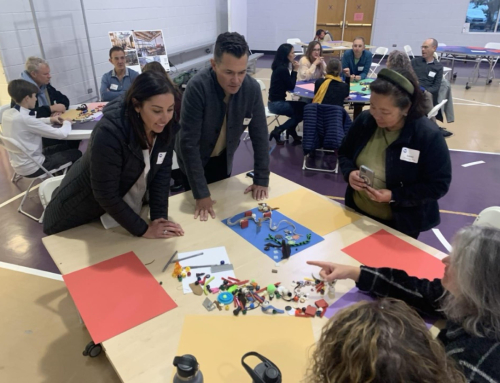
Today, at Caddis Collaborative and a lot of other good firms, we’re facilitating workshops, we’re listening before drawing, we’re observing, investigating, and being curious about what needs to influence the design work we’ve been asked to do. We’re asking people what they need and helping them develop their own understanding about human habitation through observation and through math and through design. And we’re helping them get a new kind of outcome. It’s new in that it puts people, rather than other influences, at the center of design. We embrace inclusion and the notion that we do “nothing about us without us” – people have remarkable things to offer, and you should explore the problem with them.
So much of my attitude about this work stems from my years at Carnegie Mellon, and I’m so fortunate to have found a group of architects at Caddis who share this vision. We have recently hired another talented CMU grad, Rachel Baker, and it has been fun to share stories and memories of that time. Thanks to Professors Dane, Loftness, Smith, and Lewis for lighting the way and for approaching their work with humility and humor.
Recent Posts
- Ideas at Play: How Adults Can Design for Children November 25, 2025
- Designing for Adults with Intellectual and Developmental Disabilities November 18, 2025
- Trauma-Informed Design: Inclusive Buildings for All November 11, 2025
- Neuroscience and Architecture: What Science Teaches Us About Designing Buildings for Mental Health and Well-Being November 4, 2025
- Human-Centered Design: Making the Built Environment Work for Everyone October 28, 2025
Recent
- Ideas at Play: How Adults Can Design for Children
- Designing for Adults with Intellectual and Developmental Disabilities
- Trauma-Informed Design: Inclusive Buildings for All
- Neuroscience and Architecture: What Science Teaches Us About Designing Buildings for Mental Health and Well-Being
- Human-Centered Design: Making the Built Environment Work for Everyone
Other Relevant Insights







We’re proud to be in good company.
We love being part of the community that’s bringing good design to good people. That’s why we contribute to and participate in these organizations – so we can bring the best emerging ideas to you.
Get In Touch
Let us bring your vision to life.
A beautiful space that fits your best life. A sustainable build. A fun and easy design process. We’re with you every step of the way – from the beginning dream to the finished project!
